

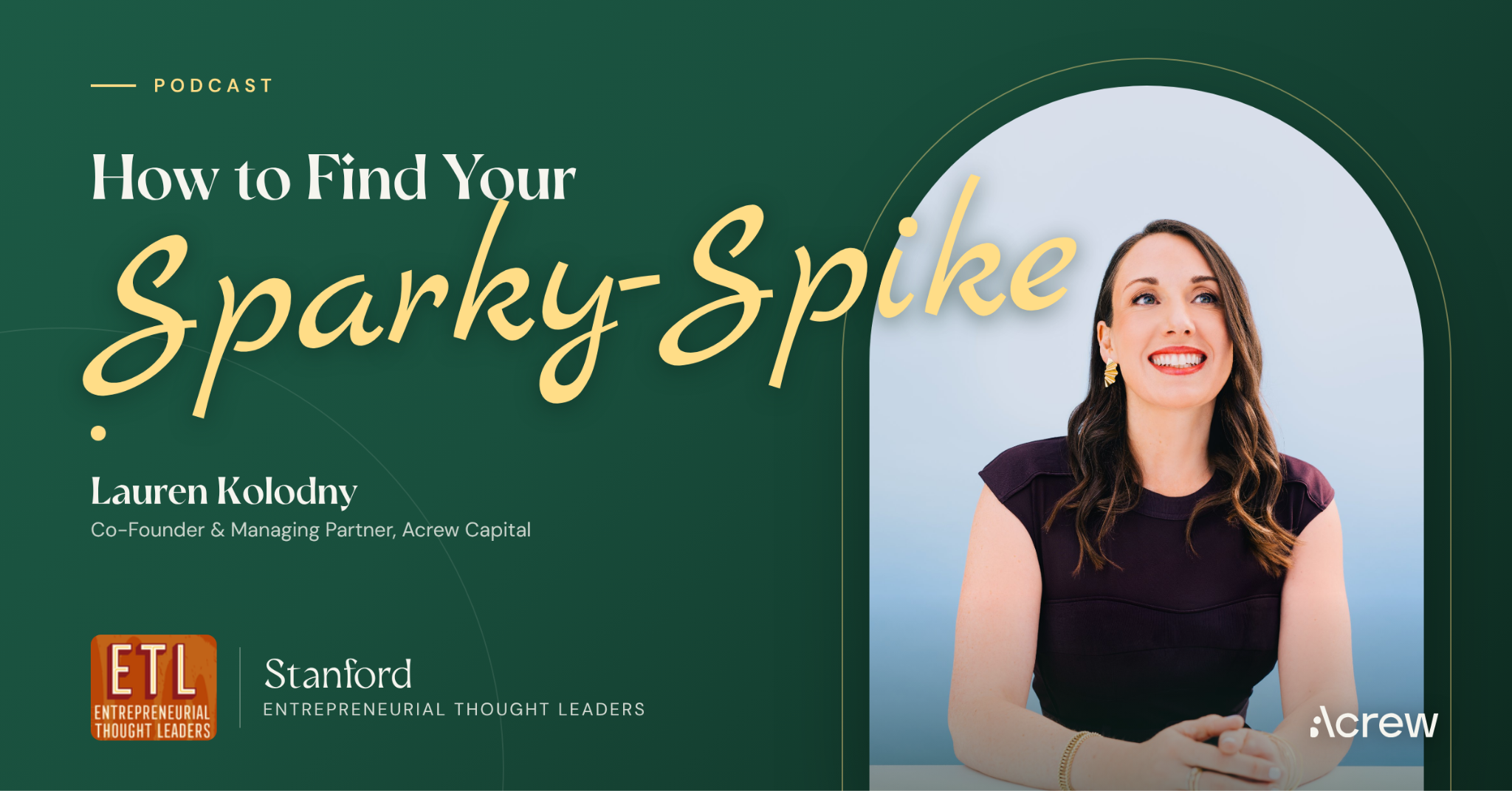
Every founder pitch answers two questions, whether or not the founder knows it: why this, and why you.
I have a name for what I am listening for in those answers. I call it a sparky-spike. It is the idea behind my recent talk at Stanford’s Entrepreneurial Thought Leaders, now out as a podcast, and it has been a guidepost for my own life and for how we think about founders at Acrew. Silly words. Powerful idea.
The Premise
A spark is intrinsic motivation. The pursuit that pulls you in and that you keep coming back to, where time stops behaving the way it normally does. It is the energy that carries a founder through every down cycle.
A spike is an outlier talent. Something you are uniquely strong at, stronger than almost anyone around you, with the judgment to see what matters and the ability to act on it.
When the two meet in the right context, that is where the greatest potential for impact lives. Every exceptional founder I have worked with had both.
What a Spark Sounds Like
One question works better than any other: think about the last time you were so absorbed in something that time went away, and when you stepped away, all you could think about was getting back to it. Personal or professional, it does not matter. What were you doing?
It is nearly impossible to answer inauthentically. And the real answer rarely sounds like a market. It sounds like a life.
A founder who grew up living paycheck to paycheck, describing the bank he wanted to build for families like his. He understood their problems so intimately that he could see solutions nobody else in the industry could, and he was driven to prove that a bank for everyday Americans could be built around their financial health rather than against it.
A founder who, after a loved one passed away, spent the better part of two years untangling what they left behind, and came out the other side unable to stop thinking about how much pain the process adds to the worst moment of someone’s life. Making that moment easier for other people became the thing she could not put down.
A founder who had been shipping voice-assistant apps since he was a teenager, and who talks about the company as a way to give people their eyes back: a future where his own kids grow up talking to computers instead of staring into them.
A security executive who had spent his career protecting governments and Fortune 500 companies, until his mother picked up the phone and heard what sounded like his sister’s voice, and a man demanding money. The sophistication he had built a career defending against was now pointed at his own family. He left to build for people like her.
What a Spike Sounds Like
Here the question is harder: what is your singular greatest outlier capability? One. You have to choose.
The best founders get there, even if it takes a minute, because they know which one thing matters most to building this company and can say why they are excellent at it. When they do, it often sounds obvious. A single insight, beautiful in its simplicity, that fits the problem so exactly you wonder why nobody built it before. They saw it when others did not.
Finding it in Yourself
The question I asked the students to take home is the one I would ask anyone: what do people come to you for above anyone else? Spikes can show up in places you would never think to look, and when something comes naturally, sometimes we do not yet see it in ourselves.
With the students, I used a party, because most of them do not have a work track record yet. But this kind of example is illustrative for anyone, and sometimes it uncovers more than a resume ever could.
Say a friend tells you the dinner you hosted last spring was the best night they had all year. Ask why. Maybe it was the people: you hand-picked every guest, got the two who never come to anything to show up, and put the poet next to the CS major because you had a feeling. They talked for three hours, and by dessert a table of strangers had become a group that still texts. Maybe it was the beauty: everyone else saw a bare dorm courtyard, and you saw a dinner party. A door on sawhorses, mismatched plates from the thrift store, jam jars of wildflowers from the empty lot out back, one strand of borrowed string lights, and it looked like a magazine shoot. Or maybe it was the execution: forty people, three courses, one burner and a toaster oven, a plan down to the minute, and everything came out hot and on time without a single visible moment of panic.
Each one is a different spike. A rare ability to draw in remarkable people and put them together so that connection just happens. Seeing the potential for beauty where nobody else does, and creating it out of almost nothing. Extreme operational execution. None of them happened at work. All of them are real.
One of my own sparks is looking for sparky-spikes in other people. If you are a founder with a deeply intrinsic motivation to solve a problem and a special strength for solving it, I would love to hear from you.
More in the podcast: https://stvp.stanford.edu/av/lauren-kolodny-acrew-capital-how-find-your-spark-and-spike